This lecture series provides an introductory course to basic notions of artificial intelligence, modeling of agents, and learning. It comprises three main parts, namely
- Part A: Introduction to Artificial Intelligence
- Part B: Modeling and Probabilistic Reasoning
- Part C: Learning Probabilistic Models
Our focus is primarily on basic forms of predictive models. In particular, we focus on two different classes of predictive models, namely probabilistic models (such as causal inference models) and linear estimation models. In the former case, we also explore the use of hidden variables that we could also assist in the detection and estimation of unobserved events.
Part A: Introduction to Artificial Intelligence
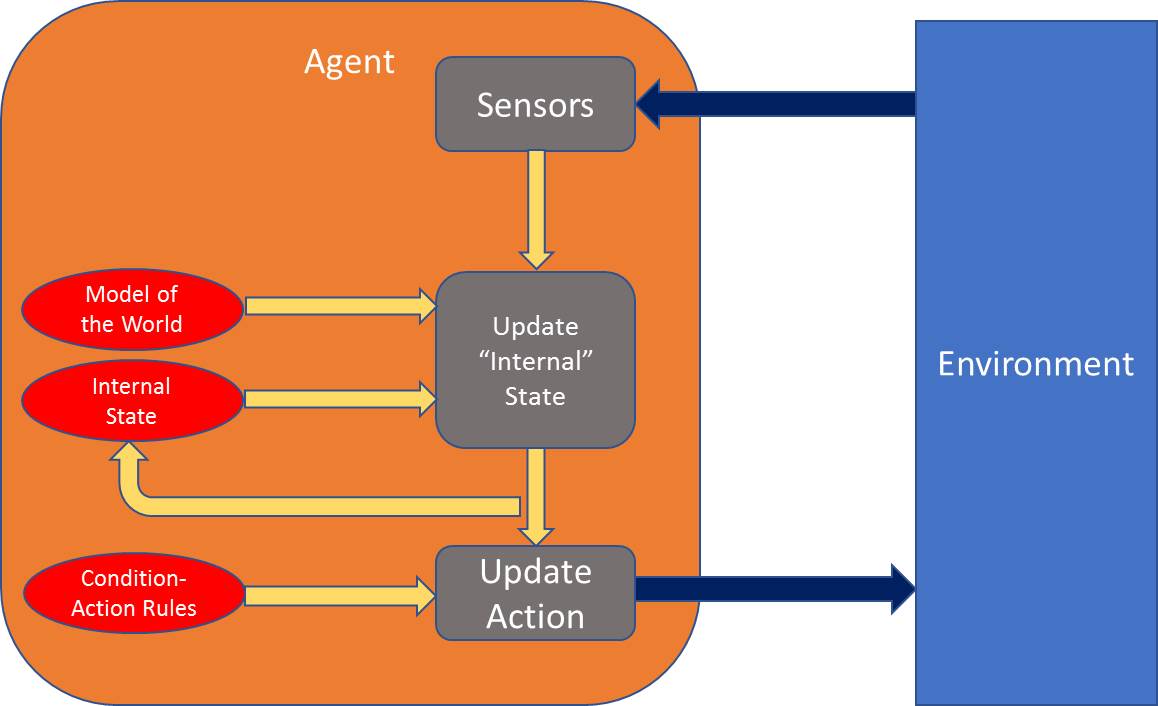
This part of the lecture series provides an introduction to Artificial Intelligence and its core elements, such as the notion of the “agent” as well as its different types (e.g., the model-based agent presented in the following figure).
Subscribe to get full access to all lectures
Read more of this content when you subscribe today.
- Lecture 1: Introduction to Artificial Intelligence
- Lecture 2: Intelligent Agents
- Lecture 3: The Structure of Agents
- Lecture 4: Examples of Agent Programs
- Homework 1
Part B: Modeling and Probabilistic Reasoning
This part of the lecture series comprises six lectures, including Probabilistic Reasoning and Exact Inference, Probabilistic Reasoning over Time (Part A and B), and Linear Models (Part A and B).

Subscribe to get full access to all lectures
Read more of this content when you subscribe today.
- Lecture 5: Quantifying Uncertainty (Probability Background)
- Lecture 6: Probabilistic Reasoning: Bayesian Networks and Exact Inference
- Lecture 7: Probabilistic Reasoning over Time (Part A)
- Homework 2
- Lecture 8: Probabilistic Reasoning over Time (Part B)
- Lecture 9: Linear Models (Part A)
- Lecture 10: Linear Models (Part B)
- Homework 3
Part C: Learning Probabilistic Models
This part of the lecture series provides an introduction to Learning Probabilistic Models.
Subscribe to get full access to all lectures
- Lecture 11: Learning Probabilistic Models (Part A)
- Lecture 12: Learning Probabilistic Models (Part B)
- Lecture 13: Learning Probabilistic Models with Hidden Variables


 My Journey with Intelligent Decision Support Systems