From Industrial Data to Actionable Knowledge: The SCCH’s Knowledge Graph Tool

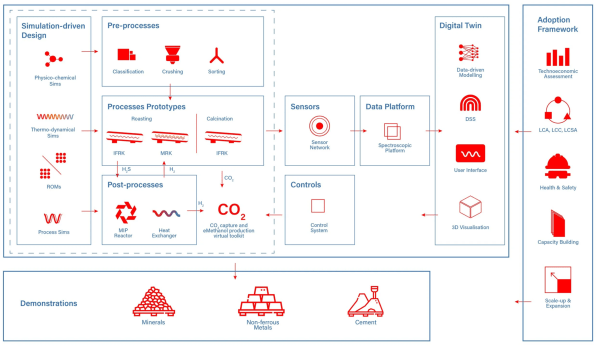
Overview We briefly present KG-CAIP (Knowledge Graph for Causal Analysis of Industrial Processes), a tool developed by SCCH within the Horizon Europe TRINEFLEX project (Grant No. 101058174). The tool automatically transforms raw industrial sensor data into interpretable knowledge graphs, making complex process interactions transparent and explainable. Unlike traditional black-box analytics, KG-CAIP focuses on understanding cause–effect... Continue Reading →

SCCH’s Role in Advancing Digital Twin Ecosystems

The Twin4Twin (T4T) project, funded under the Widening programme of Horizon Europe, aims to accelerate the adoption of digital twin technologies for smart manufacturing by fostering knowledge exchange, advanced research, and strong industrial ecosystems across Europe. A key contributor to this effort is SCCH (Software Competence Center Hagenberg), whose role spans both strategic capacity building... Continue Reading →

Generalized Input-Output Hidden Markov Models for Supervising Industrial Processes

Motivation Often in industrial processes, batches of material are processed sequentially and repeatedly through a deterministic sequence of process steps. Operators may have difficulties to properly follow and supervise them especially when there is a large number of relevant sensor measurements to be monitored. Furthermore, although the current operating conditions may be considered normal, there... Continue Reading →

Lecture Series: Predictive Modeling and Learning

This lecture series provides an introductory course to basic notions of artificial intelligence, modeling of agents, and learning. It comprises three main parts, namely Part A: Introduction to Artificial Intelligence Part B: Modeling and Probabilistic Reasoning Part C: Learning Probabilistic Models Our focus is primarily on basic forms of predictive models. In particular, we focus... Continue Reading →

PaRLSched C++ Library

PaRLSched is a C++ library for optimally scheduling parallel threads in a many-core platform using distributed reinforcement learning (and more specifically, perturbed learning automata). It explores recent advancements of game-theoretic learning techniques and reinforcement learning for asymptotically converging to efficient allocations. In particular, it exploits real-time measurements of the performances of the computing threads, and... Continue Reading →

Feature and Model Selection for Electricity Load Forecasting

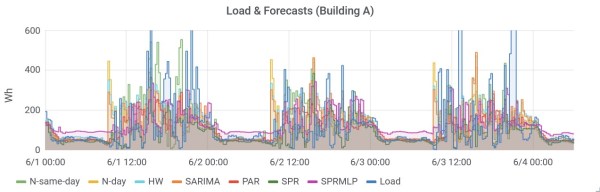
The need for accurate balancing in electricity markets and a larger integration of renewable sources of electricity require accurate forecasts of electricity loads in residential buildings. In this paper, we consider the problem of short-term (one-day ahead) forecasting of the electricity-load consumption in residential buildings. In order to generate such forecasts, historical electricity consumption data... Continue Reading →

Interview: Arbeiten am /working at SCCH – Georgios

https://www.youtube.com/watch?reload=9&v=DQbdB9gaEHI&fbclid=IwAR1DCqqvug-VXWwXRU4IuTspHrOp_zt7dmxQLE-2xg_1xU4jVs_JBhRql8s Interview: Arbeiten am/working at SCCH Recently, I was interviewed about my experience working as a researcher at Software Competence Center Hagenberg GmbH. Thought to share it in case it could possibly motivate young scientists to follow such path in their carreer. Research definitely is a way to create new paths in knowledge and make... Continue Reading →

Blog at WordPress.com.

Up ↑