Transforming Calcination and Roasting Processes in Europe
The PRIM-ROCK project (Process Innovations for the Mineral industry focusing on Roasting and Calcination Kiln technologies and supported by novel pre- and post-processing) is a Horizon Europe initiative aiming to significantly improve the efficiency and sustainability of industrial mineral processing. Running from 2024 to 2028 and bringing together 22 partners from across Europe, the project addresses one of the major challenges of modern industry: how to produce essential materials while reducing environmental impact and energy consumption.
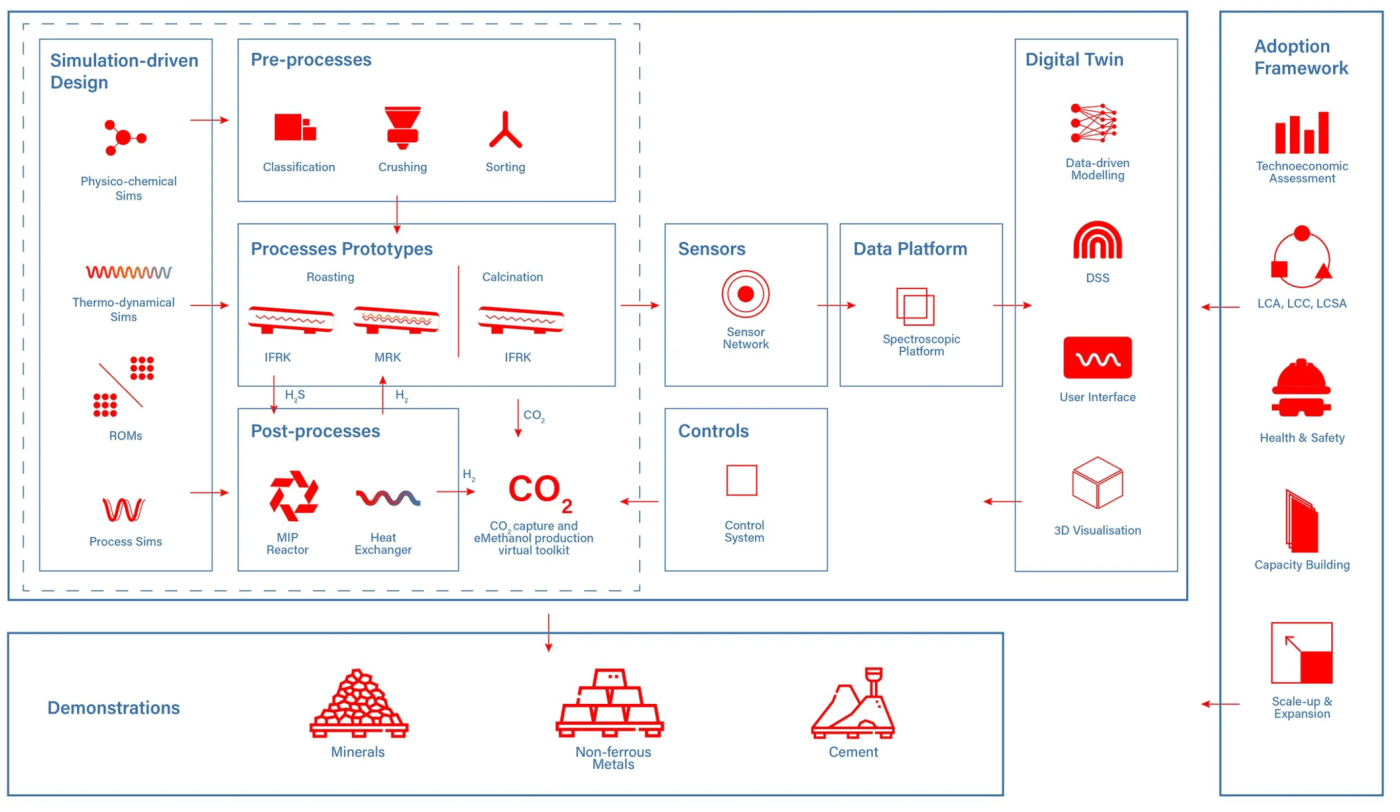
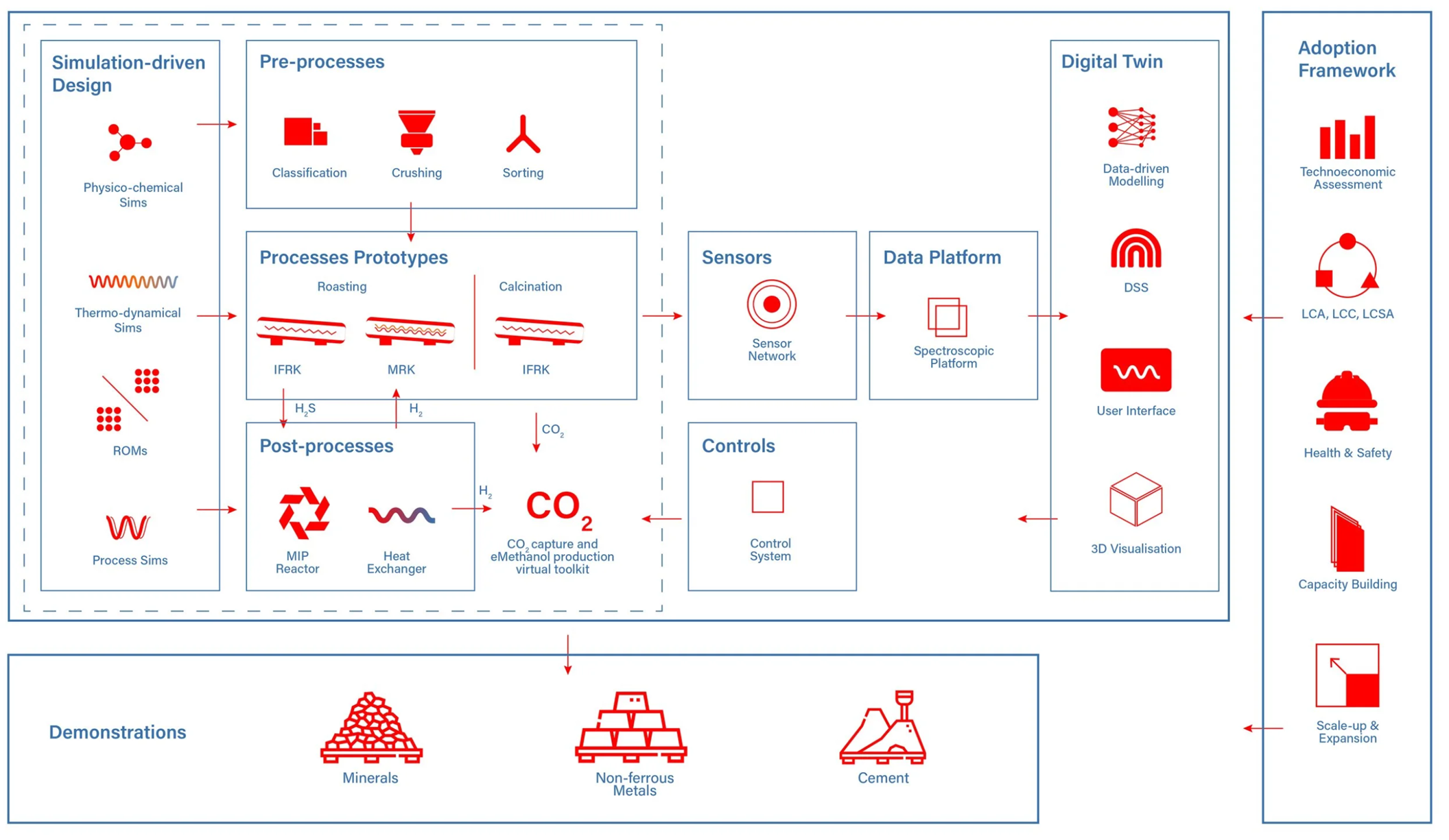
Calcination and roasting are key thermal processes widely used in industries such as minerals, cement, and non-ferrous metals. However, these processes are traditionally energy-intensive and often rely on fossil fuels. PRIM-ROCK aims to transform these processes by combining innovative thermal technologies, digitalization, and advanced data-driven approaches to enable more efficient and sustainable production. A high-level description of the PRIM-ROCK framework and innovations are depicted in Figure 1.
At its core, the project adopts a holistic approach across the entire industrial value chain, addressing three main stages of mineral processing:
- Pre-processing: Advanced techniques for raw material preparation, including improved sorting, classification, and optimal crushing size determination.
- Processing: Development and demonstration of innovative kiln technologies, including electrified indirect-fired rotary kilns designed to replace conventional fuel-based furnaces.
- Post-processing: Novel solutions such as microwave-assisted plasma reactors that enable the recovery and reuse of hydrogen from process gases, improving overall energy efficiency.
A key component of PRIM-ROCK is the integration of digital technologies and artificial intelligence into industrial operations. Through the development of digital twins and AI-driven decision-support systems, the project enables better monitoring, prediction, and optimisation of industrial processes. This allows operators to adapt processing conditions in real time, respond to changes in raw materials, and reduce waste and emissions.
The technologies developed in PRIM-ROCK will be demonstrated in three major industrial sectors:
- Minerals (e.g., magnesite and laterite)
- Cement (limestone processing)
- Non-ferrous metals (e.g., sphalerite and chalcopyrite)
By combining technological innovation with digital intelligence, the project aims to achieve over 30% improvement in resource efficiency, significantly reduce greenhouse-gas emissions, and support the transition toward a low-carbon and circular industrial economy.
SCCH’s Contribution: AI-Driven Models for Process Monitoring and Optimisation
Within the PRIM-ROCK consortium, the Software Competence Center Hagenberg (SCCH) contributes its expertise in artificial intelligence, data science, and advanced modelling. SCCH leads key work in the development of data-driven models for monitoring and optimising thermal processes, particularly focusing on the calcination process.
The work carried out by SCCH is part of Task 5.2: Data-driven model development, which aims to create predictive models capable of supporting process monitoring and operational optimisation for both calcination and roasting.
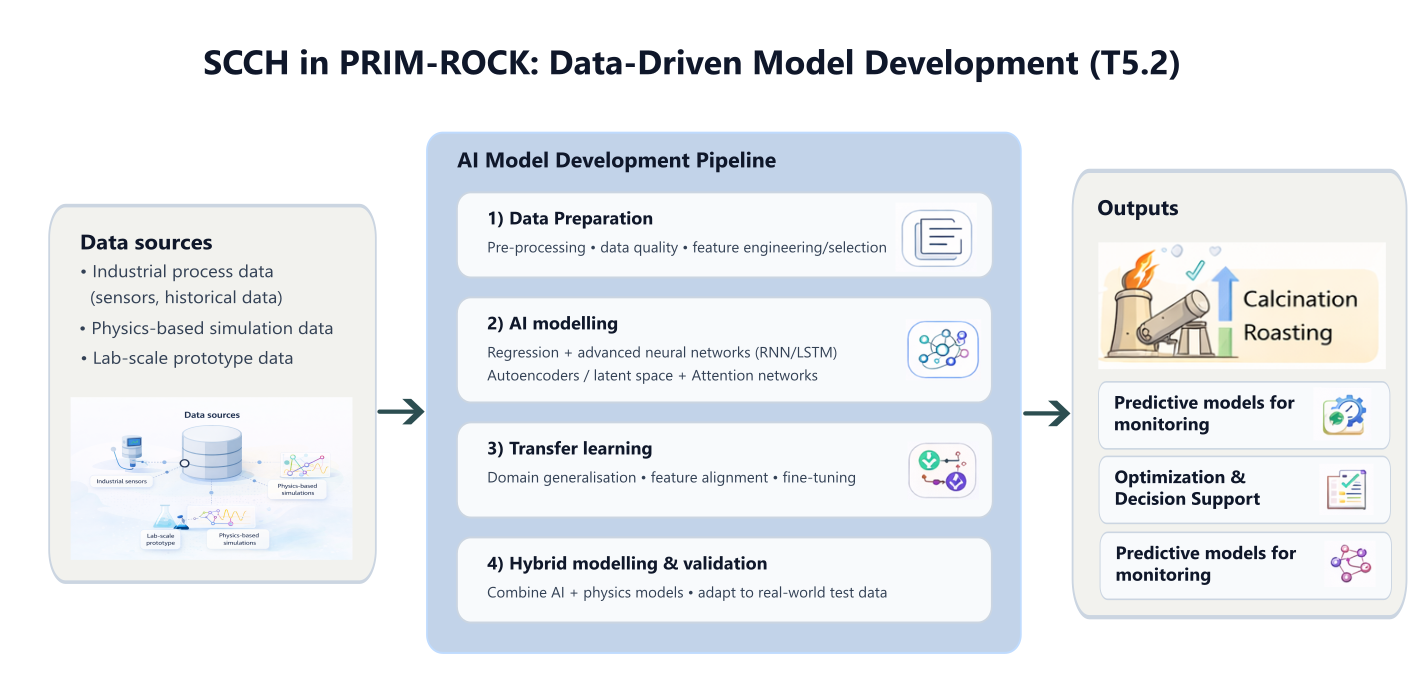
The development of these models follows a multi-phase approach which is visualized in Figure 2.
Data Preparation and Feature Engineering
The first phase focuses on preparing and analysing process data. This includes:
- Data pre-processing and quality assessment
- Feature engineering and feature selection
- Integration of expert knowledge and physics-based insights
These steps ensure that the available industrial and experimental data can be effectively used for modelling and prediction.
Advanced AI-Based Modeling
Based on the processed data, SCCH develops predictive models using modern AI techniques. A range of modelling approaches are explored, including:
- Linear and nonlinear regression models
- Recurrent neural networks (RNNs)
- Long short-term memory (LSTM) networks
- Variational autoencoders
- Attention-based neural network architectures
These methods allow the models to capture complex temporal patterns and latent relationships within industrial process data.
Transfer Learning and Hybrid Modelling
In the second phase, the models are enhanced through transfer learning and hybrid modelling approaches.
Transfer learning techniques enable the models to incorporate additional data sources, such as:
- Data from lab-scale prototypes developed in the project
- Simulation data from physics-based process models
This allows the models to generalize across different operating conditions and improve robustness. Hybrid modelling approaches then combine AI-based models with physics-based simulations, further enhancing prediction accuracy and reliability.
Validation with Real-World Data
As the project progresses and experimental setups become operational, the developed models will be adapted to incorporate real-world data from pilot installations. This will enable validation and fine-tuning of the models to ensure that they accurately represent the real industrial processes.
The final outcome of this work will be a set of data-driven models for calcination and roasting processes, supporting improved monitoring, optimisation, and decision-making in industrial mineral processing.


 My Journey with Intelligent Decision Support Systems
Leave a comment